

Jinnoji Temple
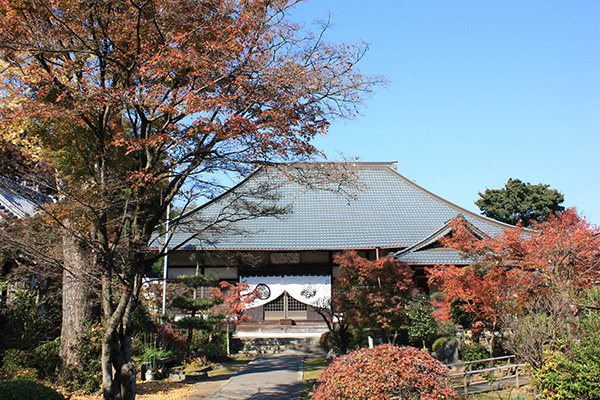 Main Hall
Jinnoji Temple is located on the northeastern side of Mt. Otokoyama, across a valley from Iwashimizu
Hachimangu Shrine. The temple grounds are covered with fringed irises that bloom in springtime, and
the many maple trees attract visitors both in the spring, when the leaves are fresh and green, and in
the fall, when they turn brilliant shades of red and yellow.
It is said that Jinnoji was founded by the monk Gyokyo in 860, shortly after he established Iwashimizu
Hachimangu. The temple was originally built to house a memorial tablet honoring the spirit of Emperor
Ojin, the legendary fifteenth emperor of Japan, who is also worshipped as the deity Hachiman at
Iwashimizu Hachimangu. Jinnoji changed Buddhist school affiliations several times throughout history
and has been a Soto Zen temple since the Muromachi period (1336–1573). Under the 12th chief abbot,
Jinnoji was recognized and revered by powerful figures such as Toyotomi Hideyoshi (1537–1598) and
Tokugawa Ieyasu (1543–1616). Other Tokugawa shoguns after Ieyasu also upheld this recognition.
The main hall houses the temple’s principal object of worship, a statue of Yakushi, the Buddha of
medicine and healing. It also contains a statue of Toyotomi Hideyoshi in court regalia that is thought
to have been an offering from his son Hideyori (1593–1615), and a seated statue of the founding monk
Gyokyo dating from the early Heian period (794–1185). The Gyokyo statue was originally enshrined at
Iwashimizu Hachimangu, which was historically a shrine-temple complex that practiced a syncretic
fusion of Shinto and Buddhism. After the government ordered the separation of the two religions in
1868, the statue was transferred to Jinnoji. It is now a nationally designated Important Cultural
Property.
The area in the valley below the temple is called Okunoin and contains several halls. One is dedicated
to Fudo Myo-o, a Buddhist Wisdom King, another houses a statue of the Eleven-Headed Kannon, the
bodhisattva of compassion, and yet another enshrines the bodhisattva Jizo, the savior of all sentient
beings. Some worshippers also visit Okunoin to engage in ascetic waterfall mediation at the Hikime
waterfall.
The upper grounds of Jinnoji and the valley area are accessible to the public, but a tour of the main
buildings requires a reservation. Please note that inquiries are accepted only in Japanese.